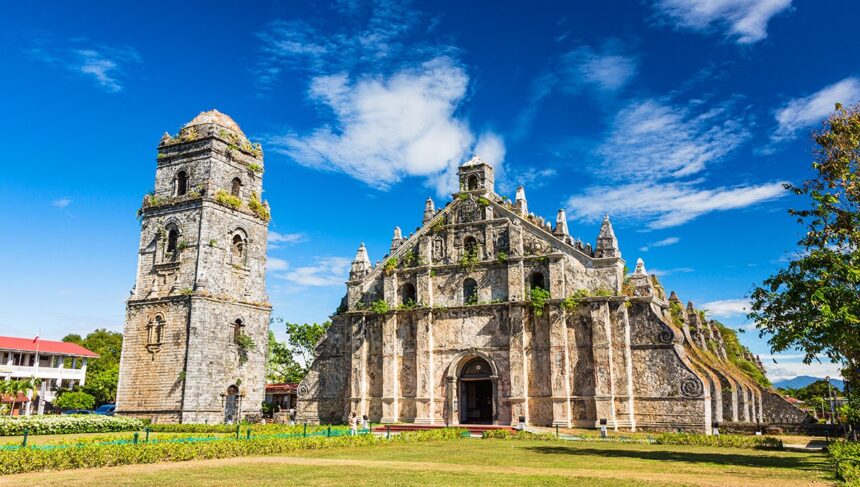
Being among travellers who have spent their fair share of nights, as the sun descends like a scalding coin below the horizon of the West Philippine Sea, I have come to know a deep-seated fact: we travel not to see but to feel. We want to hear the footsteps which paced the earth many centuries before us, in search of the tales told by stones, long weathered, both by the fury of tropical storms and by the flame of revolutions. When seeking out the most evocative historical places in the Philippines, we find that every landmark tells a story of resilience. If you are a student of heritage asking what the historical places in the Philippines that define its identity are, you need only look at the scars and triumphs etched into its landscape.
There is a very good reason why the Philippines is commonly regarded as a land of turquoise water and powdery white sand. It is a paradise of the senses.
And so the end of all our searching will be to reach the path we started and see the place as we have never seen it. – T.S. Eliot
Behind the jade of its tropical haze, you will discover a soul made by fire, religion, and an uncompromising freedom of spirit. You see that this archipelago is not a place of arrival; it is a breathing, living chronicle of man and his strength. If you are looking for the most significant historical places in the Philippines, you must look beyond the shoreline. Indeed, the famous historical places in the Philippines are often those that stood firm against the tides of colonisation.
Hello, dear travellers, and welcome to time travelling. We will now take a stroll through the five most beautiful and expressive historical sanctuaries in the Pearl of the Orient. This guide will lead you through the echoes of the past.
History is an art gallery, whose originals are few and copies many. – Alexis de Tocqueville
The history in the Philippines is, however, original, raw and very heart-wrenching. Take your curiosity, a feeling of wonder, with you, and we are heading to a place where the past is not a memory but a reality that never leaves as soon as you get there.
1. Intramuros: The Walled City of Memories (Manila).
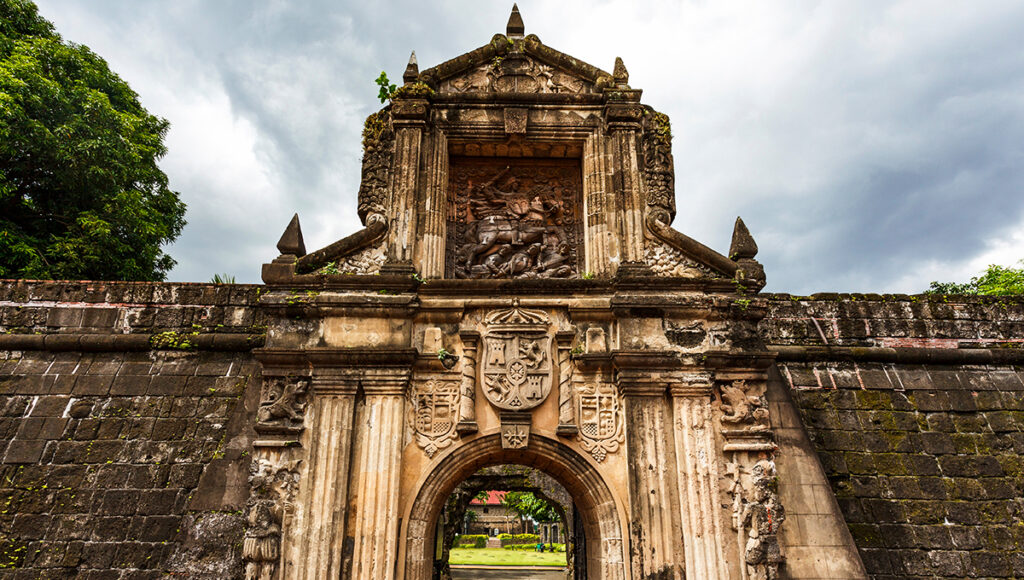
The silent sentinel Intramuros is in the very core of the busy, modern heartbeat of Manila. Its very name signifies “literally within the walls”, and as you pass its great stone gates, the noise of the city is heard no more, but a low whisper. It remains one of the most visited historical places in the Philippines today. When considering which historical places in the Philippines offer the most gravitas, Intramuros is the undisputed answer.
Along this walk, it is as though one is walking through an old-world dream. These three-mile-long stone walls were constructed by the Spanish in the late 16 th century and were meant to secure the capital of the colonies against pirates and other foreign invaders. They preserve the heritage of a nation today. When considering which historical places in the Philippines offer the most gravitas, Intramuros is the undisputed answer.
What makes it special: Do not just look at the walls; touch the mossy stones of Fort Santiago. It was the last prison of this Philippine national hero, Dr Jose Rizal. When you walk along the pavement, which has the bronze footprints of his last walk to execution, you get the deepest impression of the sacrifice that brought this nation into being. It is arguably the most essential site on any list of historical places in the Philippines.
My Traveller Tip: To have a truly magical time, avoid the use of modern taxis and get a kalesa (horse-drawn carriage). When you hear the clip-clop of the hooves against the cobblestones of Calle Real, and the golden hour sunshine strikes the Baroque facade of the San Agustin Church, you will hardly think that you are in the 21st century.
2. Vigan: Where Time Stands Still (Ilocos Sur)
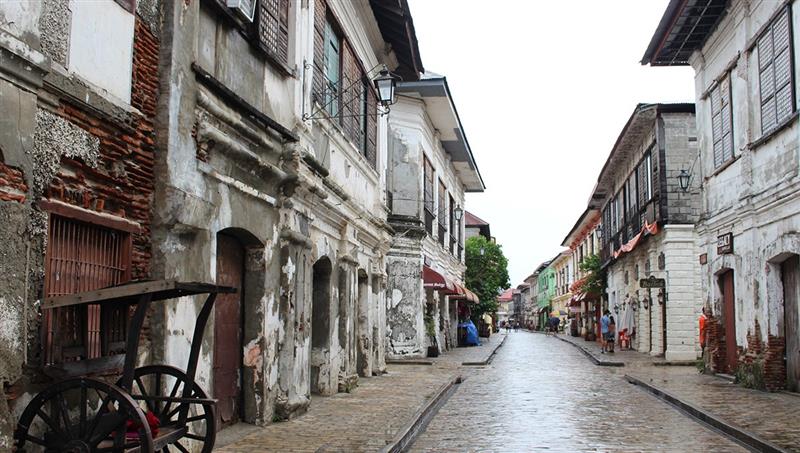
Vigan, a tribute to an older time, is in the silent North of Luzon. When other cities were quickly moving towards the future, Vigan preferred to hover around the elegance of its Spanish colonial heritage. Its streets are not the walks of a tourist; it is the veins of an ancient town, wonderfully maintained. Among the many historical places in the Philippines, this city offers the most seamless transition into the past. As one of the famous historical places in the Philippines, it serves as a testament to preservation.
The Beauty in the Details: Calle Crisologo is the crown jewel of Vigan. In this case, the avenues are covered with cobblestones, and the sides with bahay na bato (houses of stone) whose huge wooden doors and fragile Capiz-shell windows are a characteristic feature. They were taken directly out of the sea and put in place of glass in order to permit a gentle, pearly feel to diffuse into the large rooms without letting the tropical heat enter.
The reason why it is unique: Vigan is a hybrid city. It is not only Spanish architecture but a beautiful blend of Filipino, Chinese, and European architecture. It can be traced in rooflines and in the fine inlaid carvings of wood. The shadows of the old mansions play on the stones at night, as the streetlamps flicker on, and the air is filled with freshly baked empanadas and ancient wood.
3. Corregidor Island: The Rock of Valour (Manila Bay).
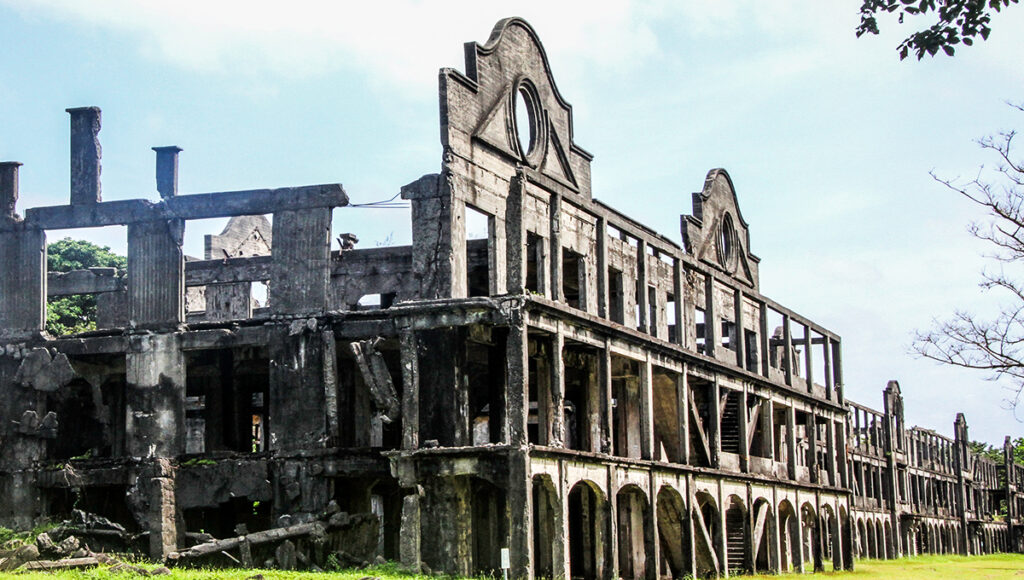
It is only a brief ride on a ferryboat through the glamour of Manila Bay to a land of silent gloom and spooky beauty: Corregidor. This fortress, shaped like a tadpole, was the final protection for the Philippines and the United States against World War II. For those tracking the military historical places in the Philippines, this island is a sombre necessity. Many travellers booking with World Pinoy Flights ask, “What are the historical places in the Philippines that showcase bravery?” and Corregidor is always the reply.
The Visit: Paying a visit to Corregidor is a humiliating visit. You will behold the skeletal structure of the former four-storey compound, the so-called Middleside Barracks, which now is the haunting waste of concrete and rusted steel, the jungle regaining possession of it. It remains one of the most historic places in the Philippines for its role in the Pacific War.
The Hidden Gem: The Malinta tunnel is the core of the island. The hospital and the headquarters, which were bombproof, are at one time a walk through the damp, cold rooms as one listens to the audio-visual display of what happened to the soldiers during their last days. It is a space that makes us remember that peace is a precious gift, and that was purchased by the people who lived before us.
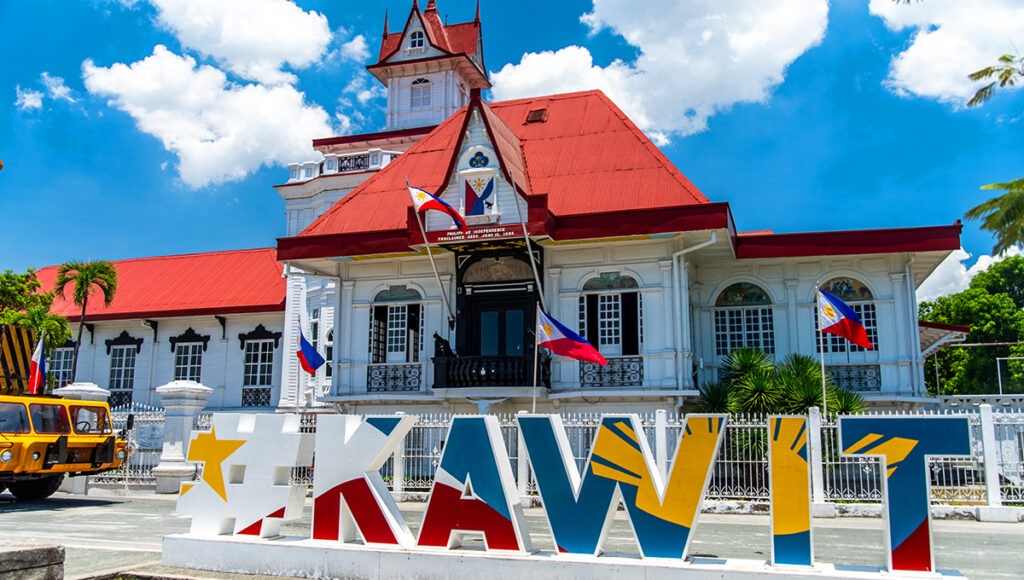
4. The Aguinaldo Shrine: Birthplace of a Republic (Kawit, Cavite).
Each country has a cradle, and in the case of the Philippines, it is this great, white mansion in Cavite. The Aguinaldo Shrine was the family house of the original president of the Philippines, General Emilio Aguinaldo. It stands proudly as one of the essential historical places in the Philippines for understanding the nation’s sovereignty. To many, it ranks high among the famous historical places in the Philippines because it marks the end of colonial rule.
Beauty in the Architecture: The house is a masterpiece of revolutionary architecture in itself. Aguinaldo was a secretive man, and his home is indicative of that. When you make a sightseeing visit of the rooms, see the “secret passages” (sunk-out pillars and flooring) which conceal tunnels that were used to escape during raids or to transport documents without being noticed. It is often cited when curators compile a list of historical places in the Philippines that feature architectural ingenuity.
A Reflection of a Traveller: When you stand in the “Balcony of Independence” (which the General added years afterwards), looking out over the trimmed gardens, you can almost hear the cheers of the crowds more than a century ago. It is a spot of great pride, and the memory of a young-born nation is still haunting the sea air. This is also a great opportunity to explore beautiful islands in the Philippines nearby, making your journey a blend of history and nature.
5. History: Leyte Landing Memorial: The Promise Kept (Palo, Leyte).
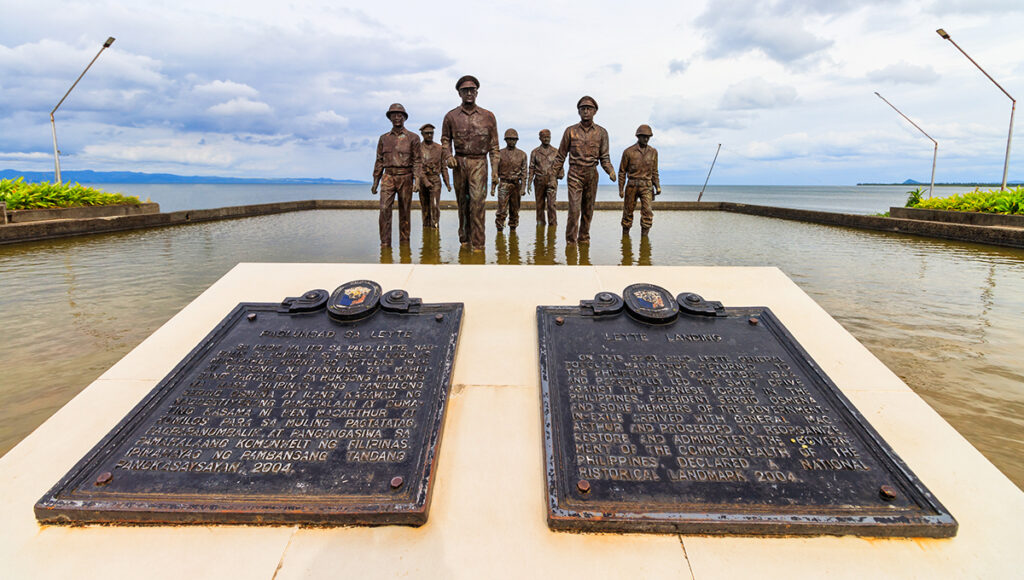
On the beaches of Red Beach, Palo, Leyte, there is a series of larger-than-life bronze images that appear to be wading in the water towards the land. This is the Leyte Landing Memorial Park, where General Douglas MacArthur arrived back in the Philippines in 1944 and made his famous vow: ‘I shall return.’ Even among the most distant historical places in the Philippines, this site draws thousands who wish to honour that return. While often appearing on the most historical places in the Philippines maps, the surrounding provincial sites are often considered underrated historical places in the Philippines.
The Artistic Beauty: The statues are located in a shallow pool of water, representing the time when the Allied forces visited it on their knees to commence the liberation of the islands. The size of the monuments in contrast with the Pacific Ocean is something incredibly stirring.
What is unique about it: It is an open and airy park, in contrast to many historical places in the Philippines that are surrounded by walls. It is a location where the local people jog, have family picnics, and children play with kites. This mixture of a grave war memorial and the colourful life of the present is a distinctly Filipino one. It depicts that the people never forget the past, but they always move towards the sunshine of the future. These memorial attractions remind us that history is alive.
For the modern traveller, Tourism Promotions Board (TPB) offers a wealth of resources to help you navigate these cultural landscapes, ensuring that your journey through the islands is as seamless as it is enriching.
A Parting Word for the Road
To my friends, the Philippines is a tale that is told in a multiplicity of tongues, the melodic strike of native gongs, the grave Latin accents of Spanish churches, and the inspirational melodies of a new republic. While many travel for the beaches, those who seek the historical places in the Philippines will find the true heartbeat of the islands. Don’t forget to explore the underrated historical places in the Philippines that lie hidden in the provinces. These tourist attractions offer a window into the soul of the nation.
You cannot come and leave without taking a photo when you visit such historical places. Sit for a moment. Touch the adobe walls in Intramuros, feel the wind in the ruins at Corregidor, and see the light fall on the cobblestones of Vigan.
History is not merely a matter of dates, but it is a matter of the soul. And the heart of the Filipinos is ready to embrace you with open arms and a tale that will linger long after you have lost your tan, making your Philippines holidays an unforgettable immersion into a heritage of resilience.
Safe journeys, and may your travels be as rich and beautiful as the history you read.
FAQs about Historical Places in the Philippines
What is the most important historical place to visit in Manila?
The most vital place in Manila is intramuros or the Walled City, which houses Fort Santiago and the San Agustin Church.
Where is the best place where one can find well-preserved Spanish colonial architecture?
The town of Vigan (Calle Crisologo) in Ilocos Sur is the best place to visit because of its cobblestone streets and native bahay na bato houses.
Where am I to hear about the participation of the Philippines in World War II?
The island of Corregidor at Manila Bay is a melancholy place containing the ruined barracks and the ancient Malinta Tunnel.
In what place did the Philippine Declaration of Independence originate?
The Aguinaldo Shrine, located in Kawit, Cavite, is the ancestral house of the first president and the womb of the Philippine Republic.
What is the Leyte Landing Memorial Park?
It marks the homecoming of General Douglas MacArthur in the Philippines in 1944, as he had promised to assist in freeing the nation.