I have travelled the world in pursuit of joy, of the excitement of discovery, and yet there was nothing at all to prepare me for Christmas in the Philippines. Forget the cold, forget the snow, and don’t even think of Christmas as just a day. Here, Christmas is a four-month-long fiery act of faith, food, and love of family. It is a glorious sensory overload that you have to witness.
People always discuss what they see when they pass, and one of my friends said to me once, Let the details pass; simply speak to the heart. A tourist does not simply witness Christmas in the Philippines; they are full of the experience even before their calendar changes to September.
This is my personal guide, from one fellow traveller to another, highlighting 10 traditions unique to the Philippines that come together to make Christmas here the biggest, warmest, and most authentic in the world.
A Closer Look at Filipino Christmas Traditions
1. The Months Blitz: The Longest Celebration in the World (Ber)
To travellers who are either UK or European-based, the Christmas season starts with the beginning of December; it is a shocking experience in the Philippines and their culture. In this case, the season starts on 1st September.
This marks the beginning of the months of the ‘Ber’ (September, October, November, December). It is not a gradual approach to the season but a rush-bang-bang. Being a traveller, you will see that houses and shops are being decorated with twinkling lights and pompous decorations even though the air is hot in summer. Even the view of grandiose illuminated Christmas lanterns in the Philippines hanging among the mango trees and palm fronds is quite fascinating. The sheer scale of these festive decorations is what sets the Filipino Christmas apart.
The importance of this event is that the Filipino people are able to spend more time in preparation, reflection and, above all, family reuniting. It is a season-long, joyous anticipation, and the actual Christmas Day is the finale of a four-month national celebration. It preludes a sense of unwearying optimism and welcome that pervades every part of the archipelago.
2. The Music of the Season: The Eternal Melody of Jose Mari Chan
Filipino Christmas songs are the order of the day in every country, yet in the Philippines, there is one man who is above all, Jose Mari Chan.
The moment September comes, his 1990 smash, “Christmas in Our Hearts”, takes over the airwaves. You will read it in the malls, in every jeepney and in every house. It is a gentle, lyrical and heartfelt hymn regarding the true sense of the holiday.
The presence of this song everywhere is an interesting cultural aspect for a visiting traveller. It turns out to be the emotional climax of the whole season. You will even be humming along, even though the lyrics may not be known to you yet. It is not merely a song, but it is a cultural landmark that has been used as a reminder of the beginning of the most joyful period in the year of every Filipino, no matter where he or she may be on this planet. It is a wonderful ode to the strength of music to bring people together.
3. Sepul: The Nine-Day Pilgrimage at Dawn
The main feature of the Filipino Christmas traditions is the Catholic worship called Simbang Gabi (literally, ‘Night Mass’, or in Spanish, Misa de Gallo, Misa de Gallo’ in Spanish means ‘Mass of the Rooster’.
The Filipinos risk their lives to attend nine consecutive masses within these days, 16th December to 24th December. Being an explorer, it is a total necessity to be a part of this tradition. You shall come up when people are quiet in the streets, and you shall be the one to see the air charged with expectation as the churches are crowded with religious worshippers.
The religious devotion it takes to accomplish all nine masses of Simbang Gabi is regarded as an effective sacrifice and a religious devotion. It is said that when you manage to go through with the Novena (the nine days), any special request you make will be fulfilled. It is more magnificent than the spiritual reward, a communal experience. It is an experience to be standing shoulder-to-shoulder with thousands of locals in the pre-dawn cold air and waiting on the Christmas miracle. It is a strong statement of shared hope that is truly unparalleled in other places.
4. Puto Bumbong and Bibingka: After Mass Delicacies

After the Simbang Gabi mass is over, the actual cultural reward starts immediately outside the doors of the church. The church grounds instantly turn into mini-food markets, where hot rice cakes done in traditional ways are sold.
The Puto Bumbong and Bibingka are the stars of this post-mass feast:
- Puto Bumbong is a sticky rice dumpling that has been steamed inside bamboo tubes, which gives it a peculiar cylindrical shape with a deep purple colour. It is customarily accompanied by melted butter, shredded coconut and brown sugar.
- Bibingka is a firmer and softer rice cake baked in a clay oven covered with a banana leaf, usually accompanied by salted duck egg slices and cheese.
They are not just snacks, as they belong to the ritual. The rice cake is warm, and the cup of intense Filipino hot chocolate (tsokolate) is the best way to get the much-needed comfort following the early mass. To the traveller, sampling these festive foods is a mouth-watering, hot potato peep into centuries of Filipino food culture, which is the warmth and sweetness that goes well with the spiritual devotion.
5. Parol: The Star of Bethlehem Reimagined
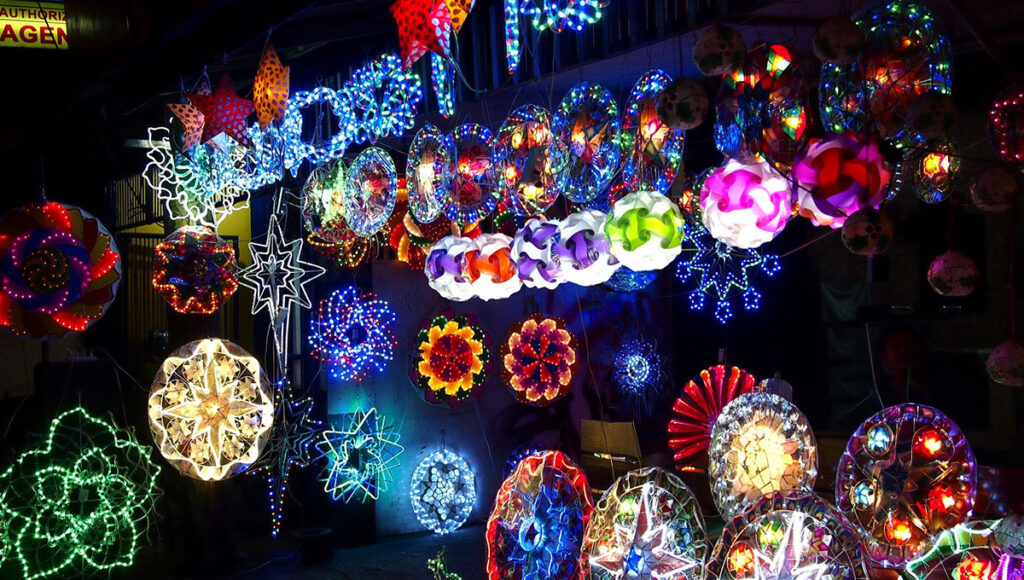
The Filipino Christmas has the most beautiful and iconic symbol: the Parol, or the lantern in the shape of a star. The Parol, which was inspired by the Star of Bethlehem that led the Three Kings, is indeed more than a decoration; it is a shining symbol of light and hope and national spirit. The traditional ones are traditionally made of bamboo and Japanese paper, but the contemporary ones are sophisticated, motorised, and adorned with blinking and rhythmic LED lights.
You will find a light competition as you pass through cities such as Iloilo or provinces outside Manila. All the windows and all the street lamps and all the public places will be hung with these beautiful, radiant Christmas lanterns, Philippines. They light up the way home of travellers and are a radiant light that greets the Holy Family. It is a beautiful sight to see an entire country illuminated by millions of handmade stars, which proves that the Philippines is the Christmas Capital of Asia. And also, the National Commission for Culture and the Arts recognises parol-making as a vital part of Filipino cultural heritage, celebrating it as both a traditional craft and a symbol of the Filipino spirit.
6. The Fierce Festival of the Belen (Nativity)
Global nativity scenes may be found in many places; however, the Filipino Belen (named after the Spanish word, Bethlehem) is a unique cultural art.
The Filipinos push the exhibition of the Holy Family to extreme levels of creativity. At home, at work, or, above all, at the centre of a town, you are likely to find the Belen, from the delightful simplicity of homemade figures to enormous, life-size dioramas, which consume as much landscaping as lighting, and occasionally even movement.
The enthusiasm in this case is the creativity and the fusion of the divine and the material of the place. One may often find figures wearing a textile which resembles the weaving of indigenous people or placed in a landscape that appears particularly Filipino. Such displays are an activity that binds the community and family and, in many cases, the focus of family and community gatherings, a physical, colourful reminder of the purpose of the season. Learning about Filipino Christmas traditions through the Belen is fascinating.
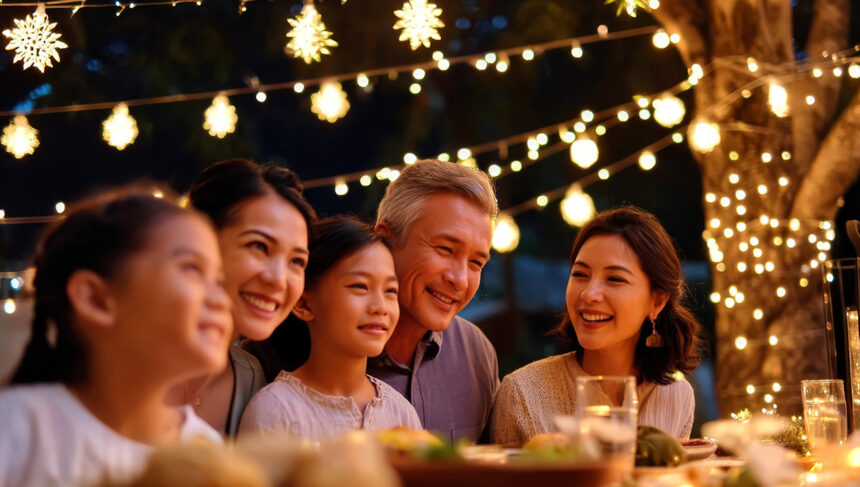
7. Noche Buena: The Great Midnight Supper
Christmas Day lunch is not the primary Christmas event in the Philippines, but Noche Buena, the huge, extravagant dinner eaten after the midnight mass on Christmas Eve (24th December), is.
It is the final family gathering, a dine-out with pagkakasama (togetherness). The table is full of the dishes that represent a symbol of abundance, extravagance and love, Vietnamese traditions of the centuries-old Spanish colony and Filipino staples:
- Hammon: With a beautiful glazed ham, and a sweet Christmas ham at that.
- Quezo de Bola: It is the traditional round ball of Edam cheese, which represents the wealth of the season.
- Lechon: An entire roast pig with its crispy skin (the crowning feast dish).
- The Filipino Spaghetti: This spaghetti is of the sweet style, featuring sliced hot dogs and ground meat, and is a sure favourite of all ages.
As a traveller, watching the quantity of food served, the excessive love, and the laughter that prevails at the home at 1:00 am on Christmas morning is a first-hand experience in the Philippines’ holiday celebration. The Noche Buena, unlike Boxing Day, is all about family and appreciation. This is one of the most beloved Filipino Christmas traditions.
8. Barangay Carolling: The Interminable Street Music
In the Philippines, the carolling activity has a very community-oriented taste, particularly at the Barangay (neighbourhood) level.
Beginning in early December and in some cases continuing well into the New Year, bands of children and occasionally adults go out on the streets. The instruments used to play the music are usually improvised, like the tambourine, which is made of a flattened bottle cap, or drums made of a tin can.
The simplicity and the mere earnestness of the performance are beautiful. The carollers do not expect to get coins and sweets, but the tradition is not related to earning money and rather to spreading cheer and engaging in the common spirit. The cheerful but not quite in pitch singing, which permeates the humid night air, is a signature sound of the Filipino Christmas traditions, a constant, musical indication that the community is alive and they are celebrating.
9. Ninong (godfather) and Ninang (godmother) Custom: Honouring Godparents
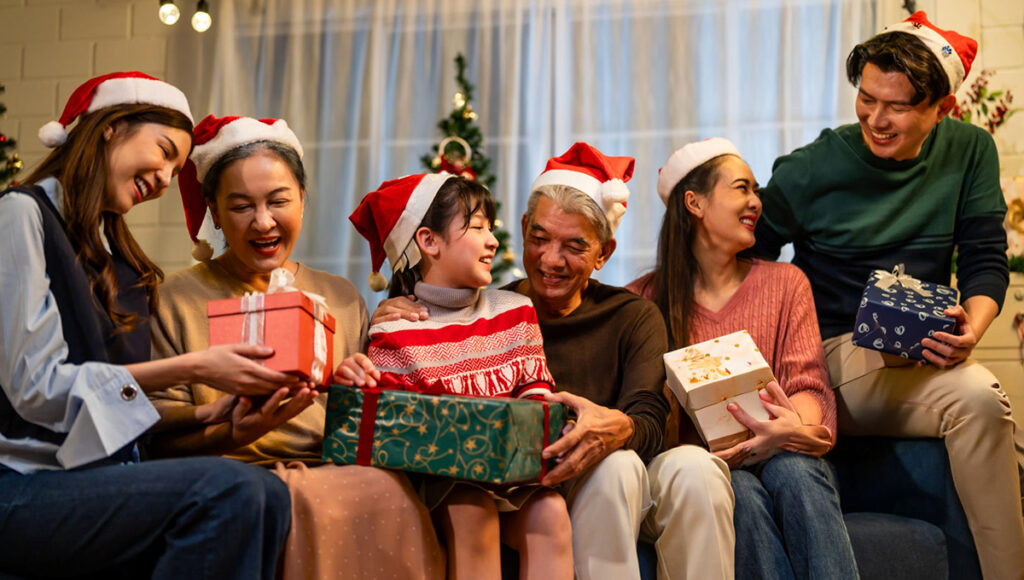
In the Philippines, Ninong (godfather) and Ninang (godmother) mean a lot to families during Christmas and at celebrations. They are not just a title, but they are a second parent, teacher of their spiritual growth, and continue to support them in all aspects of their lives.
During the Christmas season, the tradition of visiting their godparents is one way a godchild (inaanaks) can show and extend their respect and appreciation. The godparents would then give the godchild money (aguinaldo) or gifts, making this a significant moment for gift-giving.
Observably speaking, this tradition illustrates the value of extended family and mentorship in the Filipino culture. It is a meaningful ritual that reaffirms the value of kinship and social responsibility, and generosity beyond the immediate family. This is another key element of the Filipino Christmas traditions, often celebrated with a large Noche Buena feast.
10. Pagmamano and the Sacred Family Reunion

Even though Pagmamano is not actually a Christmas decoration or a Christmas event, it is a strong cultural gesture that shapes much of the Christmas party atmosphere.
Pagmamano is a given level of respect whereby a younger person graciously takes an elder’s hand and presses the back of the elder’s hand to the younger person’s forehead. It is done when greeting or coming into contact with a Ninong, Ninang, grandparent, or a significant elder.
During Christmas, this is repeated many times with many family members returning home and a party atmosphere. As a traveller, it is such a wonderful experience to witness such a simple, yet fundamentally respectful gesture. Pagmamano shows how much respect is important for a Filipino person and for their family. The use of a ritual, vibrant celebrations, food, and music alongside the twinkling Christmas lanterns in the Philippines provides a close-up of a country that prioritises culture and traditions and its cherished family values.
Conclusion: The Most Cultural Immersion
The Filipino Christmas is a four-month-long party with joy, faith, and hospitality. It brings together indigenous warmth, Spanish Catholicism, and Middle Eastern family devotion.
From the first signs of Jose Mari Chan in September, accompanied by cheerful Filipino Christmas songs, to the warm smell of Bibingka outside a dawn mass, to the loving chaos of the Noche Buena table, this tradition turns travel into cultural immersion. The warmth and community spirit of these Filipino Christmas traditions are truly unmatched.
Walking away from the Philippines, you will not just have souvenirs but a fully stocked heart with an Ilonggo heart full of the kindness, beauty, and resiliency of a people who know how to celebrate life and faith better than anyone else in the world.
With World Pinoy Flights, you can experience it all firsthand. Book your ticket for the Ber months. Your best Christmas yet is waiting for you.
FAQs about Filipino Christmas Traditions
What are the “Ber” months, and what is their significance?
The “Ber” months (September, October, November, December) are the months in which the Philippines starts the longest Christmas celebration in the world. The season is actually stopped on the first day of September when people are already allowed to hear Christmas music and see Christmas decorations.
What is Simbang Gabi, and what traditional Filipino Christmas food is associated with it?
Simbang Gabi is a religious practice where Filipinos go to church for nine consecutive early morning masses from December 16th to 24th. Traditional rice cakes like purple Puto Bumbong (steamed sticky rice) and Bibingka (baked rice cake) are made and sold from stalls set up outside the church as people come to enjoy them after the mass.
What is Noche Buena, and what are some staple dishes on the Filipino Christmas Menu?
Noche Buena is the large, festive midnight supper which happens on Christmas Eve (December 24th) after the last Simbang Gabi mass. Staple traditional Filipino Christmas food
What is the Parol and its major function?
The Parol is the characteristic Filipino Christmas lantern in the form of a star. It represents the Star of Bethlehem that led the Three Kings, and is used as a shining symbol of light, hope, and the national spirit all through the four-month season.
What is the meaning of Pagmamano and its role at Christmas?
Pagmamano is a respectful cultural gesture during which a younger person takes an elder’s hand, brings the back of it to his/her forehead, and presses it gently. It is done repeatedly during Christmas to greet and show respect to grandparents, godparents (Ninong and Ninang), and other elders at family reunions.